
ISODEC welcomes the Budget’s move from stabilisation to investment and local processing, and calls for measurable job targets, transparent execution and stronger accountability.
FOR IMMEDIATE RELEASE | Accra, 13 November 2026 The 2027 Budget responds to several of the central priorities raised by ISODEC and its partners. We welcome the decision to lower the primary surplus target to 0.5 percent of GDP and use the space for a GH¢30 billion New Economy investment programme in 2027, capital expenditure of GH¢100.4 billion, now larger than interest payments, and firm targets for processing cocoa, gold, manganese and bauxite at home, and local-purchase rules for food, textiles and medicines, with no new taxes. These commitments deserve recognition. However, the Budget does not yet turn this welcome shift into measurable commitments on jobs, transparency and equity.
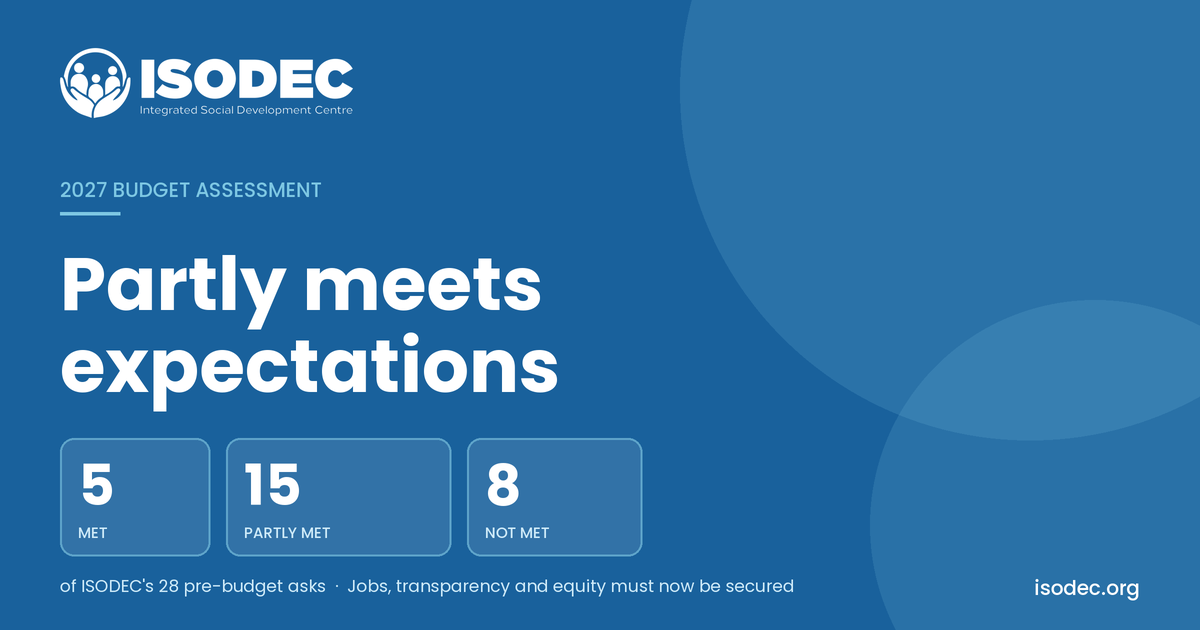
Our assessment is therefore that the 2027 Budget partly meets expectations. It delivers ISODEC’s central macroeconomic asks, a lower primary surplus target and a larger share of spending for productive investment, but it does not yet translate this shift into a measurable jobs target, transparent execution and reporting, or protections for equity and revenue integrity. In several areas, the Budget states intentions without providing measurable targets, implementation timelines, or reporting arrangements. The difference between an announcement and a funded commitment matters.
Budget at a glance: primary balance target 0.5% of GDP (legal floor 0.5%; 2026 target 1.5%); capital expenditure GH¢100.4bn, or 5.6% of GDP; employment target: none stated for 2027 (unemployment below 8% by 2030); New Economy programme GH¢30bn in 2027. Against the 28 asks in ISODEC’s pre-budget statement: 5 met, 15 partly met, 8 not met.
Stabilisation must now make room for employment and production
Ghana has made important progress on macroeconomic stabilisation. The question for the 2027 Budget is how that progress will be used to address persistent unemployment, weak productive capacity and the country’s exposure to foreign-exchange pressures. The fiscal framework should be judged by its effects on employment, inflation and the external balance, not by the pursuit of a fiscal ratio in isolation.
The announced primary surplus target of at least 0.5 percent of GDP on a commitment basis, down from 1.5 percent in 2026, needs to be considered alongside capital expenditure of GH¢100.4 billion (GH¢120.5 billion including transfers), against a record of under-execution in 2026, when primary spending ran 3.4 percent below target to October. While the GH¢30 billion New Economy allocation is welcome, the Budget speech does not yet set an execution target or commit to quarterly reporting of releases and spending by ministry, programme and region. The execution gap remains a serious concern: government must explain how it will ensure that approved capital allocations translate into completed projects and economic activity.
ISODEC will publish its detailed analysis, scorecard verdict and policy briefs.


